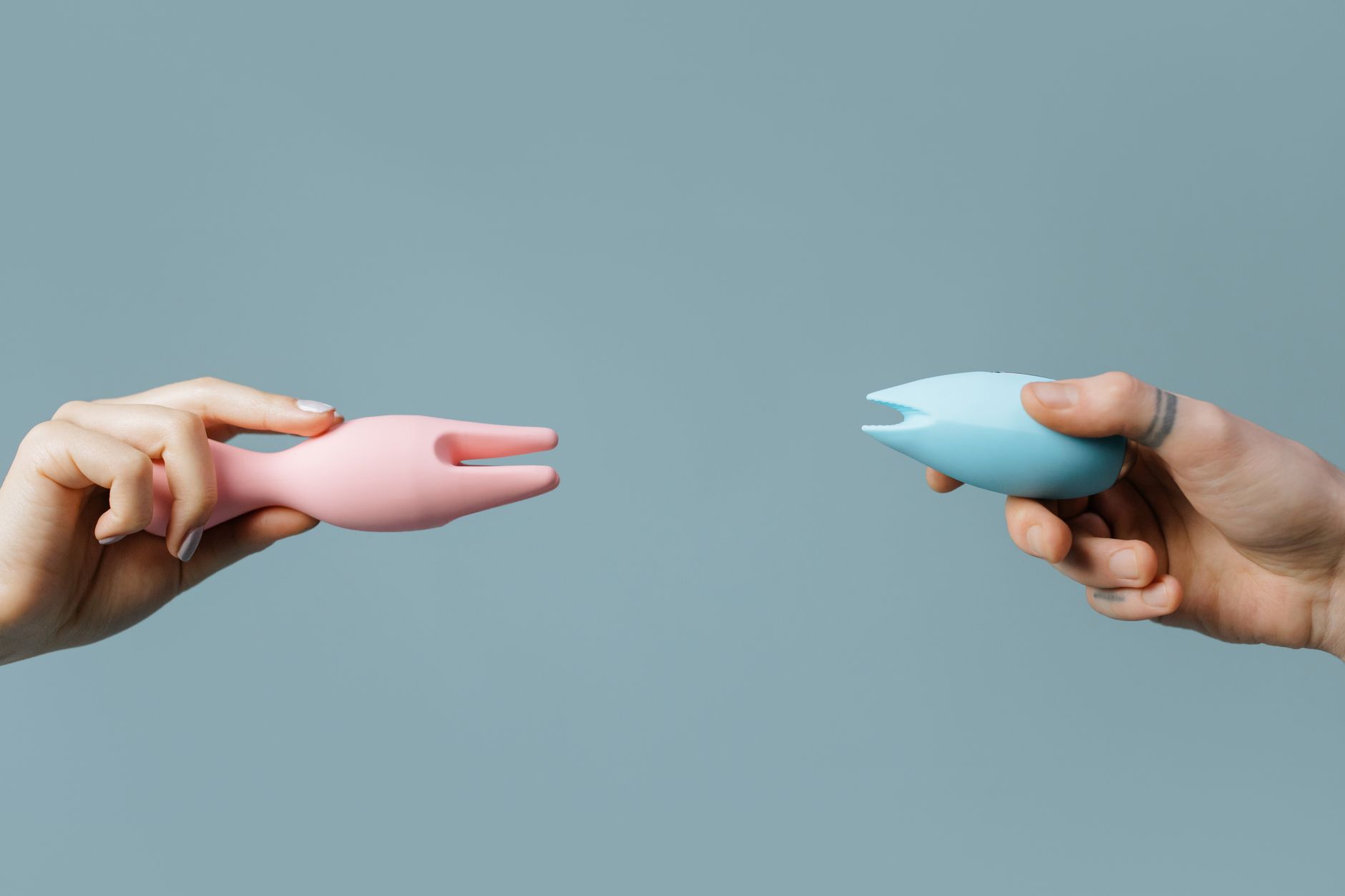
Here's what nobody tells you about your cycle
Your desire isn't broken. It's cyclical. For people with ovaries, arousal naturally peaks and valleys across your menstrual cycle. One week you're reaching for a lemon vibrator at midnight. Three weeks later, you're not thinking about pleasure at all. Both versions of you are normal.
The catch: most people ignore this pattern entirely. They assume low desire is a problem to fix instead of a phase to work with. Then they're surprised when the lemon clitoral vibrator that felt incredible last week feels meh this week. It's not the toy. It's timing.
What actually shifts across your cycle
Four hormones run the show: estrogen, testosterone, progesterone, and follicle-stimulating hormone (FSH). They rise and fall in a roughly 28-day pattern, and each shift changes what turns you on and what feels good physically.
Follicular phase (days 1-14). Estrogen climbs. Your clitoris becomes more sensitive. Blood flow increases. You're more responsive to external stimulation. A lemon vibrator's suction intensity feels accessible. Arousal builds faster. For many people, this is peak desire time.
Ovulation window (roughly days 12-16). Testosterone spikes hard. This is when sexual desire peaks for most people with cycles. You want initiation. You want intensity. You're more adventurous. This is when you might reach for higher pattern settings on your lemon vibrator and feel that clean, snappy stimulation.
Luteal phase (days 15-28). Progesterone rises. Estrogen falls. Your nervous system becomes more easily activated. Stimulation that felt perfect last week now feels too intense. You want deeper pressure, longer buildup, lower intensity initially. The lemon vibrator still works brilliantly here, but your approach changes.
Menstruation (days 1-5, overlapping). Bleeding begins. Estrogen is at its floor. Some people report zero desire. Others report wanting release and pressure relief. Some find clitoral stimulation uncomfortable. There's no universal rule here. Pay attention to your own body.
Tracking what actually happens for you
You could memorize a chart about hormone cycles. Or you could do something more useful: track your own arousal for two months.
Grab your calendar or a notes app. Every time you use your lemon vibrator, write down the date and what happened: How long did it take to feel aroused? What intensity did you start at? Did the suction feel comfortable or too much? How was the orgasm, if you had one?
After eight weeks, patterns emerge. Not textbook patterns necessarily. Your own patterns. Maybe your desire peaks mid-cycle like the research says. Maybe it peaks right before your period. Maybe you have two smaller peaks instead of one big one. Maybe you're someone whose arousal barely shifts at all.
The point is: you'll know. Then you can plan around it.
How to use your lemon vibrator across your cycle
Here's the practical playbook. These are starting points. Your body may vary.
During the follicular phase. Your clitoris is most sensitive. You're more responsive. Start with patterns 2-4 on your lemon vibrator. You might spend less time warming up and get to intensity faster. Suction stimulation feels crisp and direct. Many people report that orgasms come more easily here. If you have a partner, this is often when you want them involved.
At ovulation. This is when you're most likely to want the lemon vibrator and most likely to enjoy it. You're faster to arouse. You tolerate higher intensity. You might skip the warm-up entirely and go straight to pattern 5 or 6. Suction feels satisfying in a way it might not other weeks. Trust that impulse.
During the luteal phase. You need more runway. Your nervous system is primed for arousal but also for overstimulation. Start lower. Spend 10-15 minutes warming up with pattern 1 or 2 before moving higher. Your clitoris is still sensitive, but it's a different kind of sensitivity. It benefits from sustained pressure rather than quick, intense patterns. Slower buildup, longer duration. The lemon vibrator still delivers. You're just sequencing it differently.
During your period. Some people want nothing. Some want deep pressure on their lower abdomen. Some find that gentle clitoral stimulation helps with cramping and release. If you reach for your lemon vibrator now, start at the lowest setting. Your tissues might be more tender. Short sessions (5-10 minutes) often feel better than longer ones.
Why this matters beyond the obvious
When you sync your lemon vibrator use with your cycle, a few things happen.
First, you stop feeling broken. You realize that your desire isn't missing. It's just not constant. That's by design.
Second, you get better, more predictable pleasure. You're not fighting your body's natural state. You're working with it. Orgasms come easier. They feel more intense. You recover faster.
Third, you stop second-guessing your partner. If you're in a relationship, cycle syncing explains why you wanted them last week and feel indifferent now. It's not them. It's biology. Knowing that keeps resentment from building.
Fourth, you can actually plan around this. You know that next Thursday, mid-cycle, you'll probably want some solo time with your lemon vibrator. You can protect that time. You can prepare for it. Pleasure becomes something you're actively choosing instead of something that happens randomly.
The tracking tools that actually work
You don't need an expensive app. A notes app with dates works fine. But if you want something dedicated, Clue or Flo track both period and arousal patterns. For a no-app approach, a paper calendar where you mark "high desire," "medium," "low" takes 10 seconds a day.
The key is consistency over complexity. Track for eight weeks minimum. One month isn't enough data. Two months gives you a clear pattern. Three months gives you confidence.
What to do when your cycle is irregular
Not everyone has a 28-day cycle. Some are 21 days. Some are 35. Some skip months. Birth control, stress, thyroid issues, and aging all change your pattern.
If your cycle is irregular, tracking becomes even more important. You can't rely on a calendar. But you can still recognize patterns within your own irregular cycle. You might notice that you have two predictable high-desire windows even if the spacing isn't regular. Or you might find that desire correlates with other markers: energy level, sleep quality, stress.
The tool is the same. The pattern will just be uniquely yours.
When to use your lemon vibrator has nothing to do with your partner
Here's the thing I tell couples in my practice: your pleasure rhythm and your partner's don't need to match. They usually don't.
If you're mid-cycle and craving your lemon vibrator and your partner isn't in the mood, that's not a mismatch that needs solving. That's information. You now know that some of your peak-desire times will be solo. That's not a loss. That's freedom.
If your partner wants sex and you're in a low-desire luteal phase, you can make a different choice. Have sex. Use your lemon vibrator together. Decline and reconnect tomorrow. None of these are wrong. But knowing your cycle helps you choose consciously instead of defaulting to resentment or obligation.
How to Use a Lemon Vibrator With Your Partner for Shared Pleasure and Connection covers the partner piece more deeply if that's your situation.
The biggest shift is permission
Most people have been taught that desire should be constant, spontaneous, and equal across partners. None of that is true. Desire is cyclical. It's informed by your body's biology and your life context and your relationship state.
When you start tracking and working with your cycle, you're giving yourself permission to want what you want when you want it. You're stopping the loop of shame or confusion when desire fluctuates. You're letting your lemon vibrator be exactly the right tool at exactly the right time.
That shift alone changes everything.
People also ask
Can you get better orgasms during certain parts of your cycle?
Yes. For most people, orgasms are easiest and most intense during the follicular phase and especially around ovulation, when testosterone is highest and clitoral sensitivity is peaked. If you notice that your lemon vibrator delivers better results mid-cycle, that's not imagination. Your body is actually more responsive. That said, plenty of people report deeper, more satisfying orgasms during the luteal phase when they slow down and focus. The orgasm quality shifts, not necessarily improves or worsens.
Should you avoid using a lemon vibrator during your period?
No. There's nothing unsafe about it. Some people find that gentle clitoral stimulation during menstruation helps with cramps and mood. Others find it uncomfortable. There's no medical reason to avoid it. Pain is the only reason to stop. If stimulation hurts, stop. Otherwise, it's purely preference.
Does cycle syncing work if you're on hormonal birth control?
Synthetic hormones from birth control flatten out your natural cycle. Your desire is more steady across the month, which some people prefer. You might still notice small fluctuations, but they're usually muted compared to natural cycles. If you're on hormonal birth control and your desire feels truly flat, that might be the pill, not your body. Talk to your doctor about options.
What if your cycle is longer or shorter than 28 days?
The phases still happen, just on a different timeline. If your cycle is 35 days, your follicular phase might be 18 days instead of 14. Your luteal phase might be 17 days instead of 14. The pattern is the same. The duration is different. Track your own cycle length and map the phases accordingly.
Can you get your cycle back in sync with your partner's?
Not reliably. The "menstrual synchrony" idea (the myth that people in close proximity sync their cycles) has been pretty thoroughly debunked. Your cycle and your partner's cycle are independent. This is actually good news because it means you don't need them to want the same thing at the same time. You can work with your natural rhythms separately.
How long does it take to see a pattern in cycle tracking?
Two months minimum. One cycle gives you one data point. Two cycles give you a pattern. Three months gives you confidence. If your cycles are irregular, you might need four to six months to see a reliable pattern. It's worth the wait.
References & Sources
The hormonal patterns discussed here are drawn from cycle research published by Kinsey Institute, supported by work from reproductive endocrinologists including Sarah Hill (author of How to Upgrade Your Life) and studies on hormone fluctuations and sexual response across the menstrual cycle in peer-reviewed journals including Hormones and Behavior and Archives of Sexual Behavior.